





Like a lot of people, Ben Verhoeven, owner of Peoria Gardens in Albany, Oregon, took two years of Spanish in high school — but it didn’t really stick.
“I’m pretty sure I goofed off most of the time,” he said.
Years later, as he first worked on his family’s nursery and eventually took the reins, Verhoeven might have wished he’d paid a little more attention. As is the case at many nurseries across the Pacific Northwest, a good portion of the workforce at Peoria Gardens speak languages other than English as their native tongue.
There’s lots of Spanish, of course, but there’s also been some indigenous languages and even some Pashto, which is spoken in places like Afghanistan, Pakistan and Iran.
And while that often might make communication a little less fluid sometimes, Verhoeven — who’s continued to work on polishing up his Spanish over the years —said the benefits of the language differences present at the nursery far outweigh any kind of challenges they may pose.
“I don’t think it’s a negative issue at all,” he said. “I like to put it as an opportunity. We definitely have people who speak different languages, and absolutely it’s challenging sometimes to overcome language barriers. But it’s also an opportunity, because you can build connections and trust. If you are willing to try, to communicate as best you can, that really shows something, and it can be really valuable.”
The agriculture workforce in Oregon — and across the U.S. — has long been made up of a diverse array of workers, many of whom come from different countries and speak different languages. According to information from the Oregon State University Extension Service, 83% of farmworkers nationally identify as Hispanic or Latino; in Oregon, that percentage is likely even higher. And a study from Iowa State University found that 20% of the entire horticultural workforce in the U.S. are Latin individuals whose preferred language is Spanish.
With that kind of a demographic mix, there are bound to be linguistical bridges that need to be crossed to ensure that important information isn’t lost in translation. At nurseries, managers need to be able to communicate with laborers; workers often need to understand complicated nursery processes related to pesticides, irrigation, plant diseases and more. There are cultural differences that can be better exchanged through communication. And then there’s simply the need to be able to communicate to make a workplace enjoyable and welcoming for everyone.
It’s not always easy, but Oregon nurseries find ways to bridge the gaps.
“A language barrier isn’t just about words. It can be a cultural barrier too,” Verhoeven said. “You might have a hard time being a teammate with someone you can’t communicate with, but if you start to work toward overcoming that language barrier, you’re not just understanding words, but you start to respect them more as an individual — and vice-versa. You don’t have to be a linguist to reap those benefits.”
A common understanding
At Robinson Nursery, a wholesale grower of shade and ornamental trees, a fair amount of the 100 or so employees speak Spanish and varying levels of English. Diana Ceja, office and human resources manager for Robinson, said the company takes several steps to help ensure that communication works for everybody.
For starters, Robinson conducts annual Occupational Safety and Health Administration trainings in Spanish and English. They also provide OSHA training materials, including videos, printed and digital assets, in both languages.
“If we find any other resources that we need and they’re only available in English, I take the time to translate them,” Ceja said.
She also said that most managers at Robinson are fluent enough to communicate with both language groups. If there is ever any confusion or a misunderstanding, managers and employees will come to Ceja for clarification. That includes anytime there may be a subtle difference in Spanish dialects that don’t translate effectively even among Spanish speakers.
“Different regions have their own slang,” she said. “Some words are normal in the northern part of Mexico but offensive in the south. I try to make all those work out.”
Though Robinson doesn’t offer English language classes itself, nearby Chemeketa Community College does. Ceja says some of the nursery’s employees have taken classes there and been reimbursed by Robinson so long as they meet a certain grade point average.
“I think they do it because they want to advance a little more in the company,” Ceja says.
Including everyone
At Peoria Gardens, Verhoeven said no one is required to go and learn a new language, though some have.
“Our focus at Peoria is not on teaching you a second language,” he said. “What we have done is try to meet people where they are and also to focus on core training functions.”
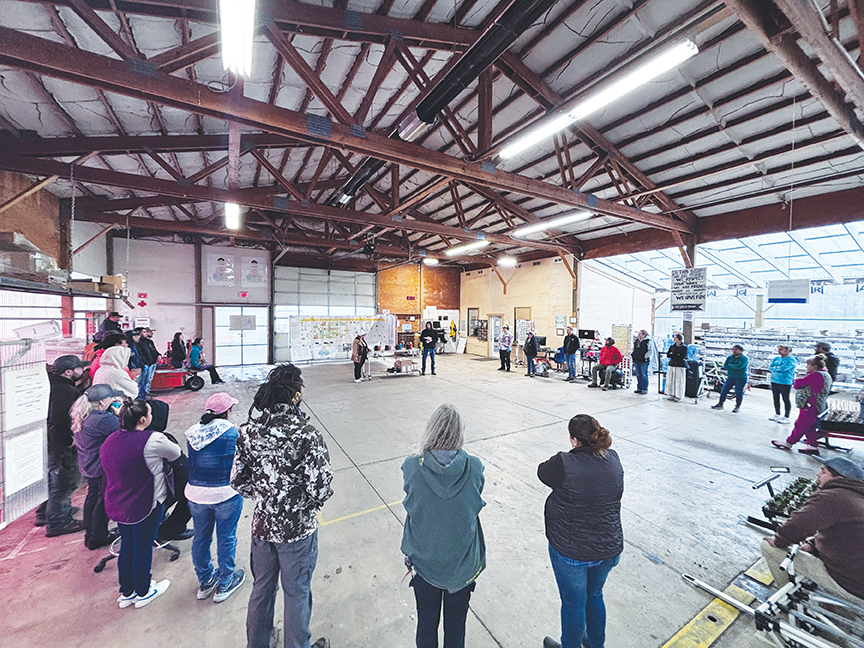
A good example of that is Peoria offering a training session for new employees on the fundamentals of Lean management practices, which Peoria uses to conduct its operations. One day the training was offered in English; the next it was in Spanish.
When Peoria has an all-company meeting, Verhoeven — who also isn’t afraid to use technology like Google Translate — has a translator from the staff translate the meeting into Spanish so that everyone is getting the same information.
“It doubles the length of the meeting, but the alternative is that a good portion of your workforce would not know what’s going on, and that’s bad,” he said. “Our goal is to make everyone feel included.”
Another benefit of having an employee translate during the all-company meeting? That employee becomes a leader and can experience growth in their career.
“That’s an opportunity for that person to grow in their public speaking capabilities and their leadership capabilities,” Verhoeven said. “I’m saying to them, ‘I’m the owner of the company. I need your help.’ So that person is not just translating. They are participating and people see that. They are being seen as leaders.”
The science behind it
For the past 16 years, Luisa Santamaria has been working to help Spanish-speaking workers in Oregon’s agriculture workforce get the training they need to flourish in their work. A professor at OSU and an extension plant pathologist at OSU’s North Willamette Research and Extension Center (NWREC), Santamaria has developed training materials, workshops and presentations in English and Spanish for nursery workers around the state.
She said one of the most important areas she focuses on is not necessarily the language, but the concepts that nursery workers need to understand, whether that’s the importance of sanitation or the proper way to apply pesticides. She also has to be able to explain those concepts simply, not only because they can be complicated topics, but because some nursery workers might have had only a limited amount of formal education.
“It’s one thing to learn the language, but it’s another thing to understand the science-based concepts,” Santamaria said. She added that incorporating hands-on activities and visual materials comes in handy. “So it’s not necessarily about helping them learn English,” she said. “It’s about helping them understand nursery concepts and what’s important.”
One of Santamaria’s current offerings is a five-module course called “Disease Prevention and Diagnosis for Nursery Crops.” Available in both English and Spanish, the course offers training on basic plant health and disease prevention. In addition to the knowledge gained through the course, those who complete it also receive four Oregon Department of Agriculture Core Credits for pesticide certification as well as preparation needed to get ready for their pesticide licensing exam.
Santamaria also plans to hold interactive plant health workshops at her office in Aurora this spring. They include “Symptom Detective (April 9), “Check Your Plants’ Moisture” (May 7) and “Scout Like a Pro (June 18). She is also available to come to a nursery in person and conduct training sessions in Spanish or English – or both.
For more information, Santamaria can be reached at luisa.santamaria@oregonstate.edu.
From the April 2026 issue of Digger magazine | Download PDF of article