



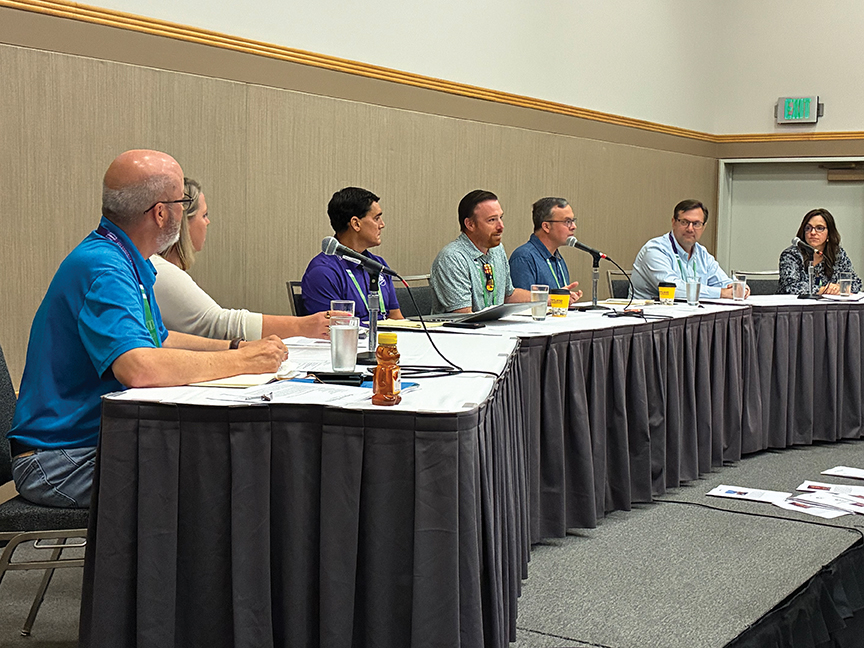
From right: Emily Rooney (executive director of the California Association of Nurseries and President of Agricultural Council of California), Tom Marting (director of sustainable solutions for Growscape), Chris Anderson (owner of Anderson Pots), Matthew Hauth (vice president of Krueger Tree Farm & Nursery), Mark Bigej (co-owner of Al’s Garden & Home), Rachel Pick (senior manager for advocacy and government affairs at AmericanHort), and Jeff Stone (Executive director of the Oregon Association of Nurseries). Photo by Tom Brewer
OAN Executive Director Jeff Stone moderated the discussion.
The topic of plastics recycling isn’t pretty, but it’s definitely complicated where Oregon’s Recycling Modernization Act is concerned.
And the 50 or so attendees of the Plastics Recycling Roundtable Thursday, August 27, at the Farwest Show were hoping that the law’s impact would be made more clear by the panelists of experts and nursery owners: Emily Rooney (executive director of the California Association of Nurseries and President of Agricultural Council of California), Tom Marting (director of sustainable solutions for Growscape), Chris Anderson (owner of Anderson Pots), Matthew Hauth (vice president of Krueger Tree Farm), Mark Bigej (co-owner of Al’s Garden & Home), and Rachel Pick (senior manager for advocacy and government affairs at AmericanHort).
OAN Executive Director Jeff Stone moderated.
Seven states — Oregon, Washington, California, Colorado, Maine, Maryland and Minnesota — all have extended producer responsibility laws. Oregon’s law went into effect in 2022, but it has been tied up in a lawsuit and was just upheld on August 27. “OAN is working with the California association and AmericanHort to create options for states to deal with this issue,” Stone said.
The law was drafted and approved to advance Oregon’s policy goal of shifting its recycling costs from governmental entities to producers. It says the producers of packaging must bear some of the costs of collecting and recycling certain packaging materials. These companies must report the quantity of packaging they distribute in Oregon and pay fees based on weight.
On the same day as the plastics roundtable, a federal judge upheld the law and rejected claims by the wholesale-distribution industry that it violated federal law or interfered with interstate commerce.
“The objective is really about trying to change how much single-use packaging is being consumed and disposed of in general,” said Marting. “During his keynote talk yesterday Prof. Charlie Hall mentioned the approx. 3.2% sales growth in our industry. If that kind of exponential growth were sustained over the long term then roughly every 20 years or so we’re doubling the number of plant sales, and in turn doubling the amount of packaging materials like plastic that we’re taking out of oil wells or forests and putting into landfills or out into the environment.”
“The intention of EPR is to try to decouple the growth in consumer packaged goods sales from the consumption of raw materials and instead create a more circular economy, where we’re able to capture and recycle materials, and as a result reduce both the consumption of virgin packaging materials we use in the first place,” Marting said. “The goal is to allow businesses to continue growing without having to grow the consumption and disposal of materials at the same rate.”
“Essentially EPR shifts the economic burden for packaging at the end of its life from taxpayers and municipalities to the producers, brand owners and manufacturers who put that material into the marketplace,” Marting said. “That requires producers to understand what materials they’re putting into the market, account for the total quantity they’re using, and ultimately to be held accountable for what it costs to manage those materials at the end of their life.”
“The idea is that materials that are harder to recycle or are worse for the environment will carry a higher fee per pound, which creates an incentive for producers to make changes.” Marting said.
Some nurseries are trying to make changes now to reduce their use of plastic or increase recycling.
At Krueger Tree Farm & Nursery, they’re using an air pruning pot called Pioneer System and they’re growing in it.
“What we’re doing right now is we’ll get to roughly a three-gallon and we’ll knock it off and then we’ll repackage [the plant] for shipment because I’m trying to get ten years or so [out of those Pioneer Pots],” Hauth said. “We also use an Ellepot machine. It’s a paper pot, but once again, it’s still sitting in a tray. We’re trying to do the best we can, and we’ve just been pushing the limits further and further.”
Part of the problem is how to get the plant material to retailers and have it be in a sellable form. “We’re even looking at some cellulose fabric that we can wrap it around with. But once again, when that goes into retail, that might be an issue because it might not be able to be watered,” Hauth said. Some paper packaging can be maybe held for 30 days, but at that point, it may no longer be sellable.
There’s also a lot of confusion about who is responsible for the packaging and who will have to pay the fee.
“Unfortunately, someone has to become responsible for those products. It has been deemed that typically, whoever’s responsible for those products is supposed to be the person who makes it retail-ready. Well, in this case, if the wholesale nurseries are exempt from that, then it gets kind of passed to the retailer because … we’re the next person down the chain,” Bigej said.
The way the Oregon law is written, it isn’t very clear who is responsible for what.
“This is how I believe its inferred, but nothing is really stated,” Bigej said. “From what I can gather, if there’s a brand on a product, whoever’s brand it is, they’re responsible for it.”
“So if we’re selling a Proven Winners product through our store, we’re not responsible for it. But if it’s unbranded, then we are responsible for that product,” Bigej said. “And by responsible, we’re supposed to report how much of that we use that goes to the consumer by weight and by product type. So it’s not that it’s just a 4-inch plastic pot that we have to figure out the empty weight on, but also what type of plastic that’s made from. We have to independently report that. I don’t know how in the world we would do it. How we would sort out all the different vendors we get from and be able to say: ‘No, that’s a branded pot. That’s not our responsibiltity. This little 4-inch pot, we sold 3,000 of these, and so that must be three pounds of this plastic,’ etc., etc., etc.”
“From our perspective that’s quite cumbersome,” Bigej said.
From the perspective of one OAN member who is a plant pot manufacturer, every black nursery pot is already recycled in this market.
“Basically, every black pot here is coming from a recycled source. And during this time, it turns out that plastic recycling on the West Coast is not very stable. We ended up co-founding a polymer recycling company,” Anderson said.
Anderson buys pots from nurseries, collects broken pots, gets post-industrial plastic from vendors who process those, and then he processes it and grinds up the plastic back into pellets to be melted and used again to manufacture plastic plant pots.
Anderson said he finds it ironic that there’s a supply-side push for recycled plastic and a demand side pull, but there’s a big gap in between for someone like him to fill the need.
But there are a whole set of regulations that makes it challenging.
“Right now I’m doing it post-industrial. As soon as I touch the co-mingled recycling stream … I become beholden to a set of regulations, rules (including wage rates) where I have to prove that the plastic goes to a responsible end-use market. At this time, it’s a disincentive for me to want to touch this stream.”
For California, it gets even tenfold more complicated. “In California, the product is not recyclable, or considered recyclable, unless it’s actually recycled,” Rooney said. “So it’s not just a function of the material, it’s what happens at the end.
“And so those milk cartons that go through schools, we see them everywhere and we all throw them into the recycle bin. And then now we’re having to track where they end up. A recent report showed they’re not actually getting recycled, so they got pulled off the ‘recyclable’ list. And now there’s finally a new facility opening in Lodi, California, where I live, and they will be able to recycle milk cartons so that helps milk cartons achieve recyclability status.”
But what’s the solution?
“Well, I think when we look at the big picture, plastics are an issue, right?” Bigej said. “And we’re a green in-industry, and so I can get behind trying to get the plastics out of the industry. I think long term, that’s what we need to do as an industry. So I think my solution would be, let’s incentivize the development of non-plastic products that will work for our industry. You know this, and I know the pot companies have been hearing this for years, but how do we get away from our reliance on plastics, and on to other materials?”
Hauth pointed out: “There’s biodegradable stuff out there, but are they even thinking about how that biodegrades and if there are microplastics in it.”
“This topic of innovating our way out of it was a primary theme at the Plastics Recycling Conference earlier this year in San Diego,” Anderson said. “It was quite well attended. And I think the conclusion from the recyclers was yes, we need to do something. Yes, things are going to stick, which I’ve heard here. My only caution and thought, as somebody who does design products is that inventing things is very hard. And then actually going from inventing to innovating to delivering is even harder.”
“I think that the other part we’ve got to look at here is we have to start working with these people who are making these laws,” Hauth said. “I don’t think they’re actually engaging with folks like us to realize the actual effect that it’s going to have, and how crippling it could be to our industry and all these industries.”