




HGC® Ice N’ Roses® Pink Promise ‘HG 1412’ PP36399

Winter Jewels® Helleborus × hybridus ‘Onyx Odyssey’
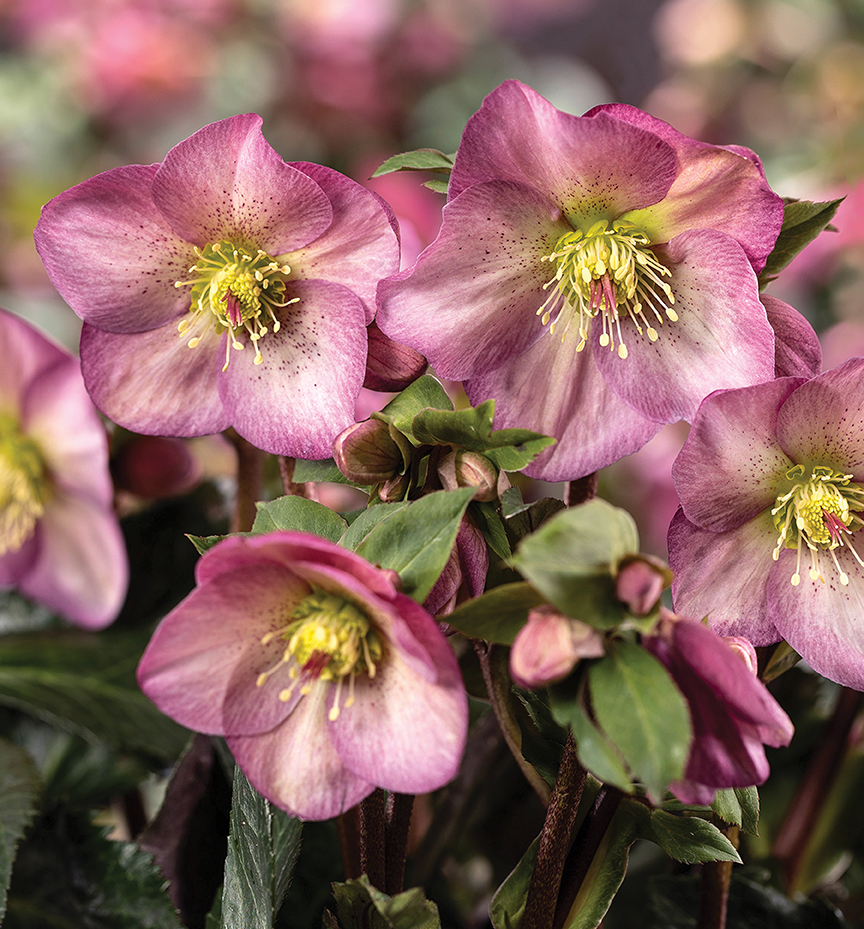
Helleborus × hybridus ‘Fire and Ice’

Helleborus x glandorfensis HGC® Ice N’ Roses® Purple Sunrise ‘HG 1428’ PP36095

Helleborus x glandorfensis HGC® Ice N’ Roses® Red Romance ‘HG 1410’ PP36512


Ice N’ Roses® Rosado Hellebore (Helleborus × glandorfensis ‘Coseh 5400’). Photo courtesy of Monrovia Nursery Company

Helleborus × ‘Walhelivor’

A selection of blooms from Little Prince of Oregon’s Winter Jewels®collection. Photo Courtesy of Little Prince of Oregon.

Winter Jewels® Helleborus × hybridus ‘Pepermint Ice’
Hellebores are riding a growing wave of interest, and why not? There’s a lot going for this plant, a winter bloomer sometimes called Lenten rose, Christmas rose or winter rose.
From new colors to extended flowering season and improved plant and flower structure, plant breeders are building a more appealing plant for consumers. One of those breeders is Little Prince of Oregon Nursery in Aurora, Oregon.
Breeding hellebores
Mark Leichty, director of business development at Little Prince of Oregon Nursery, has been growing hellebores personally for more than 30 years. He owned Fry Road Nursery in Albany, Oregon, at the time when Northwest Garden Nursery became the only Oregon nursery to start breeding hellebore hybrids and developed the Winter Jewels® collection.
“I have watched over the years as this unique line, the Winter Jewels®, came into being, and we grew and sold these beautiful plants at Fry Road Nursery,” Leichty said.
Leichty joined Little Prince in 2014 and several years later, he worked with Ernie and Marietta O’Byrne, of Northwest Garden Nursery in Eugene, Oregon, to try breeding the hellebores at Little Prince.
This small trial, however, was not successful and the idea was abandoned until 2021, when the O’Byrnes reached out again to see if Little Prince might want to purchase Winter Jewels® and continue their breeding work.
“This was an incredible opportunity, and one we were much better prepared for by 2021,” Leichty said. “We had just hired Alexa Patti, as an assistant head grower, and her attention to detail made her the perfect person to oversee and build the program into the future.”
Little Prince finalized the purchase of the Winter Jewels® collection in 2023.
Developing hellebore hybrids
Hellebores are primarily bred through hand pollination and are grown from seeds. At Little Prince, the plants are kept in a greenhouse that’s sealed off from pollinators, so they are meticulously hand-pollinated with a paintbrush.
“By doing this, we can slowly ‘steer’ the breeding of these beautiful plants to exhibit the traits we want them to express,” Leichty explained. “There are currently twenty-four distinct varieties, fifteen doubles and nine singles, with the newest addition, Winter Jewels® Golden Daffodil hellebore (Helleborus × hybridus ‘Golden Daffodil’), being a daffodil-flowered variety, which is semi-double and really does resemble a daffodil flower.”
Since Little Prince breeds all of the Winter Jewels® by hand-pollinating and producing seeds, the process of producing new varieties is a slow one. It takes several years for the seedling to flower so it can be evaluated.
Seed vs. tissue culture
Some Helleborus hybrids are produced through tissue culture. There are significant differences in production and characteristics between the two methods, said Sabine Seeling, a product consultant for North America at German-based plant breeding company Heuger.
“I think tissue culture production opened up the entire market to hellebores because they can be produced in very large numbers,” Seeling said. She added the continuous breeding from tissue culture has helped breeders improve characteristics of the hybrids too.
Other differences to consider between the seeds and tissue culture hybrid varieties are where they can be planted and how they should be treated in the garden. Hellebores generally perform better in the shade and are sensitive to the sun. But some hybrids produced with tissue culture are more heat and drought tolerant, Seeling said.
Seed varieties are harder to produce and are less uniform and less hardy in general, Seeling said. “There are significant differences between the two depending on what the grower or breeder does,” Seeling said. “The breeding has led to significant improvements in the plants and flowers and how they perform over the years.”
Extending the blooming season
Megan McConnell, plant information director at Monrovia Nursery Company in Dayton, Oregon, said hellebores are a great way to add blooms in the garden in late winter through early spring. They’re “the perfect sign of spring,” McConnell said. Monrovia grows about a dozen varieties of hellebores.
“Not only do they flower in late winter and early spring, but they are also so hardy that I’ve seen their foliage year-round with the mild winters we’ve been having in Oregon,” said Brandon Brookfield, a member of the sales team at Youngblood Nursery Inc. in Salem. “I worked at a floral design studio in Portland for five years and hellebore were always a seasonal treat for us.”
There are early varieties that bloom in November and December, there are mid-winter flowering varieties, and there are others that bloom later in February through April. By combining these different varieties in a garden, gardeners can have an extended flowering season.
Versatility
“They’re an early nectar source for pollinators and are also deer resistant,” McConnel said.
Plus they thrive in the shade and are perfect for a woodland garden, Brookfield said.
Their resistance to deer makes them popular for growers and gardeners in the Northwest and other parts of the country where deer are common, Seeling said.
Show-stopping blooms
“Whether it is a potted plant or a cut flower, they’re always a showstopper with so many colors from white, all the way to dark burgundy,” Brookfield said.
Breeders have improved plant and bloom structure, including large outward and upward facing flowers instead of the traditional nodding flowers, Seeling said. Tissue culture has also produced first-year flowering hellebores.
Seeling said breeders have also developed unique colors with different features, including dark centers or dots.
They are also producing more robust evergreen hybrids with a bigger habit that are heat and cold tolerant.
“They are producing a lot of flowers with increased disease resistance that perform well for the growers,” Seeling said.
McConnell said the outward or upward facing blooms have become the standard in the industry as opposed to the drooping blooms that were harder to see in the garden from older Hellebore varieties. She said the breeders are also focused on new colors and more flowers.
Brookfield said the new hybrid cultivars that stand out to him are in the Ice N’ Roses® (Helleborus × glandorfensis) collection.
“We introduced them to our nursery last year, this year being the first time we’ve had them on our availability,” Brookfield said. “They seem to sell very well and we’re very excited to be carrying them!”
He also enjoys the Winter Jewels® varieties for their soft pink to dark cherry-red flowers.
Brookfield said Youngblood Nursery’s fan favorite tends to be the double-flowered hellebores.
“We receive quite a bit of inquiries for these as they have multiple layers of petals instead of the usual five,” Brookfield said. “Their flowers have a great dimension to them, so I can understand why they are so sought after.”
McConnell said Monrovia is also selecting varieties that produce more abundant flowers and hold their blooms for a very long time.
“We are also looking for densely packed plants, both flowers and foliage,” McConnell said.
A long-term value for customers
“They’re such a long-lived perennial to have in the garden, and they’re robust in coming back every year in a time when there are hardly any other plants or flowers,” Seeling said. She added they are popular as cut flowers as well because of their long, sturdy stems.
“Nowadays they’re much easier to grow for commercial growers because of all the elements produced in the breeding, so they’re a great item to have in the fall and winter because growers can work with them in those times of year,” Seeling said. “It’s a great plant, and they do very well, especially here in the Pacific Northwest and in other parts of the country.”
From the September 2026 issue of Digger magazine | Download PDF of article