



and Jon Bell
The Oregon Association of Nurseries is proud to celebrate 2026 as the Year of the Woman Farmer, a designation from the United Nations, spotlighting the essential roles that women play in the nursery industry and the OAN.
“These women have helped shaped not only their businesses, but their leadership has helped shape the OAN and the Oregon nursery industry as well,” said OAN Executive Director Jeff Stone.
The United Nations designation underscores the roles that women play across agriculture around the world, from production to trade, while often going unrecognized. Woman farmers are central to food security, nutrition and economic resilience, the U.N. states. The U.N. hopes to raise awareness and promote actions to close the gender gaps and improve women’s livelihoods worldwide.
Meet five nurserywomen who exemplify the best that the Oregon nursery industry has to offer.

Kathy LeCompte is owner of Brooks Tree Farm (Brooks, Oregon) and was OAN president in 2000–01. Brooks Tree Farm specializes in connifer seedlings. Photo by Vic Panichkul
Kathy LeCompte, Brooks Tree Farm
Kathy LeCompte didn’t plan to spend a dime at the equipment auction. She’d come with her husband, Dave, for an overnight getaway. She planned to sit out the bidding in her truck — until she saw the perfect conveyor belt at a price too good to pass up.
By the end she bought nine more conveyor belts, plus a root-pruning table and processing equipment to outfit a new building they were building for their nursery, Brooks Tree Farm. Most farm buyers had little use for such specialized equipment, so she had little competition. She paid $1,800 for a conveyor belt she estimated to be worth $30,000.
One man, eyeing the belts afterward, asked if she’d sell him just one. “You mean one conveyor, or one set?” she asked — they only worked in teams of three. He hadn’t known that.
LeCompte and her husband Dave started Brooks Tree Farm in 1980 after years as long-haul truckers moving mobile homes. When their son was ready to start school they needed steady hours — and roots.
Her parents, Delbert and Barbara Hupp, owned Drake’s Crossing in Silverton and loaned them the equipment needed to launch the farm. The wholesale nursery specializes in conifer seedlings and shrubs native to the Pacific Northwest, used for Christmas tree operations as well as reforestation and restoration projects.
Growing tree seedlings required sourcing several sets of European field digging equipment, which can take weeks to months just to get replacement parts. Winter harvesting necessitated sandy soil to keep tractors from getting stuck. In the Willamette Valley, this is hard to find, often in old stream beds, so they bought farms to secure the right conditions.
Now they sell between 5–7 million plants a year across eight “inconveniently located” farms.
Kathy has served as Oregon Association of Nurseries president, as well as other executive positions, and on numerous committees, winning numerous awards for her contributions to the industry. A two-time winner of the President’s Five Star Award, she also won Young Nursery Grower of the Year and the Political Awareness Award. The nursery itself has received Outstanding Stewardship awards as well.
Yet in the early years, she was often underestimated. While at Oregon State University, a guidance counselor told her, “There really isn’t room in the horticultural industry for women.”
Early on, LeCompte called in a large fertilizer order — enough for the year — and recalled the rep asked if she had her husband’s permission to place an order.
“I said, ‘I don’t think I need that.’”
Today, however, she said the picture for women in the green industry is much more promising.
“I honestly think it’s neutral,” she said. “There are so many talented women in our industry.”
“It really is a perfect industry for women,” she added. “There’s so much automation now. There’s so much need for technical knowledge. There’s so much need for understanding of the physiology of plants — everything from being good at running an Excel spreadsheet to understanding, how lighting affects your plants. Women can do all that. That’s a completely neutral experience.”LeCompte’s political involvement started with a simple observation: no legislator can know everything about every issue they vote on, from taxes to the environment. If a decision was going to affect her business, she decided, it was on her to make sure lawmakers knew how. In 1986, immigration reform became a focus.
“I realized that the choices they’re making were impacting me directly as a business owner. So, I decided, ‘Well, I need to make sure that they know how their pending choice might be affecting me.’ I would stay current on whatever I saw they were talking about, and if it looked important to me, I’d go down and testify.”
She testified locally and in Washington D.C., providing President George Bush information on the issue.
“When no one else would do it,” she ran for the Oregon House of Representatives in 2010 and 2012, each time losing by narrow margins.
“I always joke that the same people who didn’t want me the first time still didn’t want me two years later.”
She urged every grower to get involved in their community. “If you care about your environment, if you care about your business, if you care about your taxation, if you care about any of the issues that legislators have to face — it’s worth your while to tell them how it impacts you.”
No political credentials are needed, she said — just a willingness to speak up.
“You don’t have to be an expert. You can just say, ‘I’m Susie from the block, and I’m concerned about how much my gas taxes are. I realize my roads need to be fixed, but I want you to know that you’re hitting the spin button a little too often. And I’d like to see another solution be found to keep the potholes filled that don’t involve raising our gas taxes any higher.’”
She found that just by persisting, she began to gain momentum.
“Anybody who shows up has an outsized influence. They really do.”
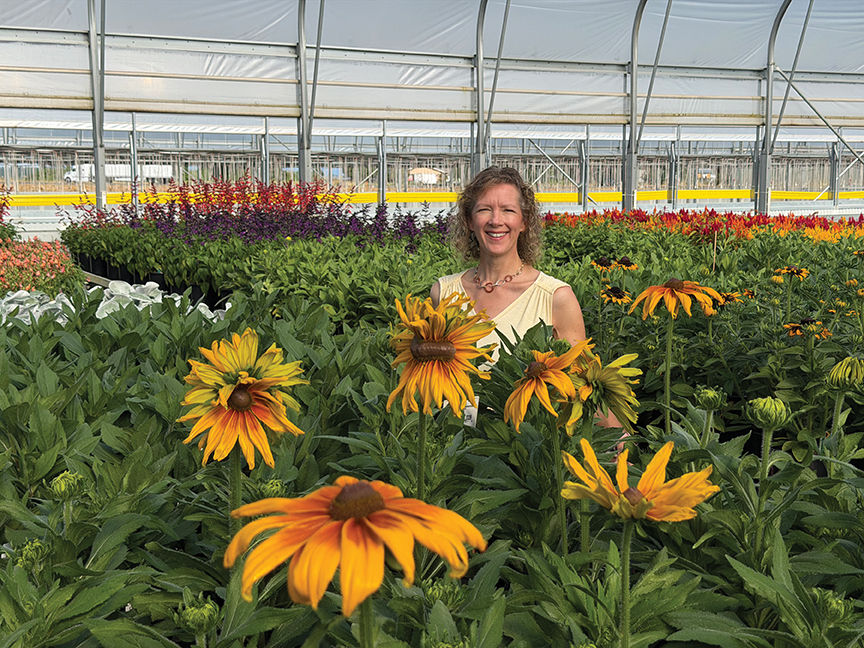
Leigh Geschwill is owner of F&B Farms and Nursery Inc. (Woodburn, Oregon) and was OAN president in 2015–16. Geschwill is also a past president of the Horticultural Research Institute. Photo by Vic Panichkul
Leigh Geschwill, F&B Farms and Nursery
After working in the “cutthroat” industry of lumber sales, Leigh Geschwill was delighted to discover the “warm and fuzzy” nursery industry when she married her husband, Fred, a nurseryman on a third-generation family farm.
Today, she is both owner and wholesale sales manager, along with Fred, his brother Bill and wife Heidi of F&B Farms and Nursery Inc. in Woodburn, Oregon.
Originally focused on field-grown strawberries and peas, the nursery shifted with the addition of the first greenhouse in 1997, selling retail. “Every generation has to add something,” she said. “This was a way to have our own income stream.”
The work was backbreaking at first. “It was everything by hand,” she said. “We were literally filling pots out of a wheelbarrow.” While they got started, she held another full-time job.
“About three years in we started to break out and do a little wholesale,” she said, where her lumber sales experience came in handy. Now, the nursery sells approximately 95% wholesale annuals, perennials, vegetables, herbs and potted flowering plants and hanging baskets. Her role encompasses “all the mini hats you wear in a small business,” from sales management and logistics to production forecasting and variety/basket selection.
“So next year will be 30 years,” she said, “and while I wasn’t born into it, I think I can safely call myself a nurseryman.”
Geschwill said she finds the industry to be highly collaborative and never saw being female in the green industry as an issue — at least in Oregon. “I was driving our delivery truck until I was 5 months pregnant,” she said. “The only reason I stopped wasn’t because I felt that I physically had to stop, but I felt it could make people feel uncomfortable, you know, to see like some big pregnant lady get out of a truck.”
She said she has seen “rather interesting behavior … that would not be acceptable here” in other parts of the country, but is impressed with the strength of networking support for women in the industry.
Geschwill highlighted AmericanHort’s programming at trade shows like Cultivate, offering a sit-down luncheon with a guest speaker, and Farwest’s Women in Horticulture networking event.
She pointed to a recent, deliberate push in Oregon to widen that circle further — inviting more Hispanic members of the industry’s workforce into the conversation, given the state’s large Hispanic agricultural workforce.
“It’s important to also make sure that we are representing some underserved communities, and getting them involved in that group,” she said, noting F & B has several women in management and supervisory roles.
Geschwill served as OAN president from 2015–16, and this year, she concluded her term as president of Horticultural Research Institute, the research arm of AmericanHort. There, she remains active in reviewing research proposals —like a recent one exploring edible mucilage plants like chia and salvia to see whether effects on the soil microbiome are reflected in the human microbiome.
Looking ahead, she said, “There’s a real acknowledgment among people in the industry that we need to have flexible tools for dealing with future problems — in particular, future pest and disease issues.”
“I’m very concerned for our urban canopies,” she added, believing they’re at serious risk. Yet the approach, she said, needs to consider all the variables. “How do we manage these issues across our country so that we mitigate spread, but we don’t negatively impact commerce?” she asked.
Likewise, she noted, “We don’t want to bring a predator in for a pest that then becomes an invasive pest itself.”
She also pushed back on blanket rules that ignore regional differences — even native plants can behave aggressively within their own range without posing a true ecological threat. ‘That all-or-nothing thinking,’ she said, ‘rarely benefits anyone in any part of society.’”
She’s lived through the vagaries of the market, from recessions to the boom of the pandemic — and the lessons they offered.
“There’s always some issue to be dealt with,” she said, “but what I remember more is that we always get through it.”
If there was a positive to the pandemic, she said, “People like a victory garden, right? It was kind of like a rebirth, where we could grow our own food. I think it’s empowering for people to know they are in control of their own health and livelihood.”
While she loves the work, it may be one of the best kept secrets in the employment world.
“We do an absolutely terrible job selling our industry. Like we’re just not ‘toot your horn’ kind of people … I think nurserymen tend to be fairly humble.”
What keeps her at work every day? “You get a real connection with nature. You just feel like you’re part of the ecosystem.” And, she added, “There are very few industries where you really are in a unique position to, generally speaking, be part of a solution.”
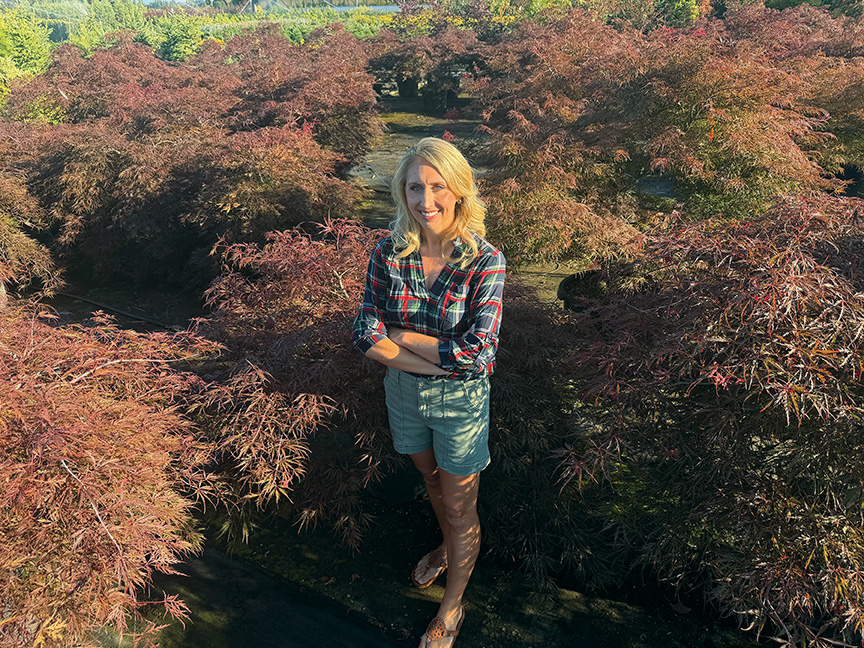
Amanda Staehely is owner of Columbia Nursery (Canby, Oregon) and was OAN president in 2023–24. Staehely is also the GOP candidate to represent Oregon House District 18. Photo by
Vic Panichkul
Amanada Staehely, Columbia Nursery
If anybody has truly had the nursery industry as part of their destiny, Amanda Staehely is it.
Born and raised in Canby, Oregon, Staehely comes from a long line of family farmers. She had vegetable farmers on both sides of her family, and she grew up on a nursery owned by her father and grandfather. Her family lived in a home on the farm, as did her grandparents, and though she didn’t really work in the nursery growing up, it always surrounded her.
“We rode bikes through the greenhouses,” Staehely said. “I would help with the annual sales they had. I went to the Farwest Show. I even remember being really little and I would play in the lab while my mom was tissue culturing. That’s definitely how I grew up.”
Her fate was further sealed when she met her future husband, Wayne Staehely, in high school. He’d grown up on a dairy farm in the area, loved plants and always wanted to have a nursery. Today, the couple owns and runs Columbia Nursery LLC in Canby, specializing in larger maples and conifers.
Yet despite all the signs pointing Staehely in the direction of nurseries along the way, another pursuit took her down a completely different path for a good part of her life: ballet.
From a young age, Staehely was a committed and highly successful ballet dancer. It was her passion, and it found her dancing with the New York City Ballet, the Houston Ballet and the Pacific Northwest Ballet. When she was a senior in high school, Staehely landed a professional contract with Oregon Ballet Theater, who she danced with for four years.
Then, during a practice, Staehely, 22 at the time, injured her ankle badly. She had to have reconstructive surgery. Her professional days were done.
“That ended the career,” she said. “It was something that was, obviously, devastating at the time. But looking back now, I was able to really help focus on getting things started here at the nursery, which led us to where we are now.”
Her ballet career sidelined, Staehely can still satisfy her creative cravings by teaching ballet at a local studio her aunt owns. After the injury, she fully committed to the nursery, the lifestyle and the industry. She and Wayne grew Columbia Nursery from a rented greenhouse to a rented piece of property to their current location, a former nursery they purchased in 2013 — the same nursery that had inspired her husband to want his own someday.
“We had a newborn baby at the time and just jumped right into this,” Staehely said. “It was really fun to kind of come full circle and help make my husband’s ultimate dream from when he was little become a reality.”
At the same time Columbia Nursery was coming into its own, Staehely began to get more involved with the nursery industry, including with the Oregon Association of Nurseries. She already knew people from other nurseries and made even stronger connections with folks who were eager to help other farmers any way they could.
“I believe that Oregon has the most superior plant products, and I think everyone here recognizes that and so they’re willing to better the nursery stock and product around the state by helping everyone else,” Staehely said. “Everyone is willing to put out a hand and help people.”
After many years in the industry, including a stint as president of OAN, Staehely began to realize that many of the political powers that be weren’t really in sync with nurseries. She felt that concerns over issues like labor, taxes, water rights, funding to fight Japanese beetles and others weren’t being heard. She started to speak up across many levels.
“I just felt like it was one thing after the other that we were fighting or advocating for, and it was just like no one was listening,” Staehely said.
Then, news came out that the state representative in Staehely’s district, Rick Lewis, would be retiring. Seeing the opportunity, Staehley threw her hat into the primary ring last spring and won the Republican nomination. She’s facing independent Roy Kaufman in the November general election.
“This is an opportunity to kind of be in there day in and day out and have a seat at the table,” Staehley said. “I want to be able to advocate for and support a community that is so important to me.”
Only November will tell if Staehley will prevail in her latest endeavor. In the meantime, she’ll continue plowing ahead, focusing on her campaign, her nursery and the family she and her husband are raising on the farm.
They have three kids now, and already there are signs, as there were in her early days, that farming may be in their future. One daughter loves to help with pruning, and their oldest son, who’s 12, has his own business where he grows blueberries on the farm and sells them at the local farmers’ market.
“I think they love living on the farm,” Staehley said, “and I can definitely see farming in their blood.”
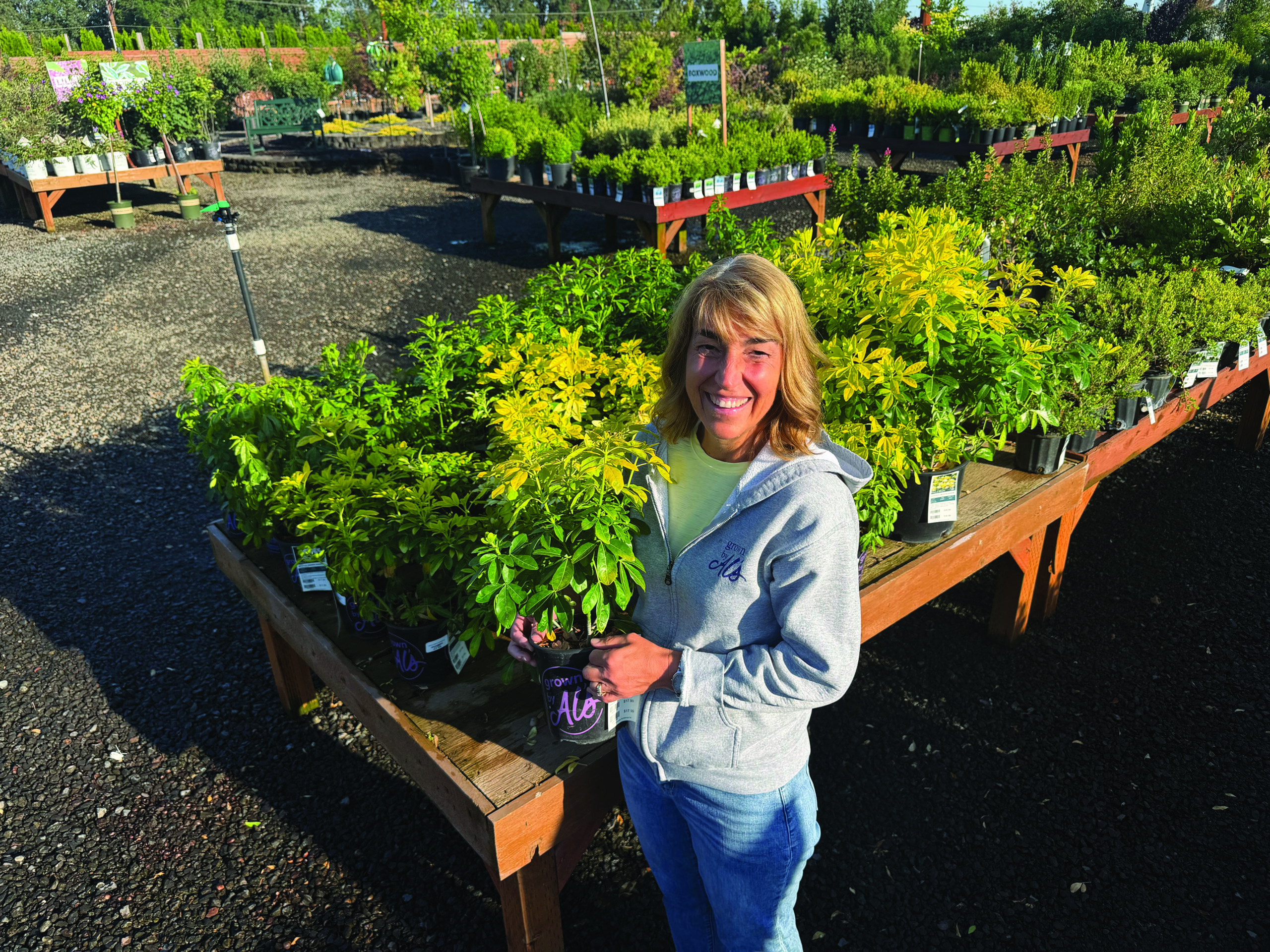
Darcy Ruef is chief financial officer of Al’s Garden & Home (Woodburn, Oregon) and is president-elect of OAN. Al’s Garden & Home is a retailer with 4 locations, but it also grows much of its own plants. Photo by Vic Panichkul
Darcy Ruef, Al’s Garden & Home
“We enjoy, as Dad would always say, the ‘bleeding edge,’” said Darcy Ruef, chief financial officer of Al’s Garden & Home.“We are one of the vertically integrated grower retailers. We grow about 60% of the green goods that we sell through our four retail locations. We do wholesale some on the side, but mostly what we produce runs through our own retails.”
That means growing two years ahead — a bet that doesn’t always pay off. However, she said, “…we have a chance to affect the outcome on the retail side. If we’re long on something, we can push it through the retail with a sale or some other form of promotion. It gives us the illusion of being in control when we’re not.”
Ruef, great-granddaughter of Al Bigej, founder of Al’s, was actively looking for other work when life intervened. After college, “while I was looking for a job, my dad needed help with the business itself.” Her father, Jack Bigej had bought out his brother and was short on employees.
“So, I just jumped on staff to help him out, and by the time I was offered another job, I no longer wanted it.”
Her siblings, Dorothy Russo and Mark Bigej, lead growing and retail operations respectively.
As OAN’s president-elect, Ruef takes office in November. She said she is interested to “know a little bit more about how the industry operates, getting to know more members of it, but also how the industry operates politically and how we can make changes in certain things that we need to have changed for our businesses.”
Regarding her platform, the said, “Instead of being out there trying to grow and make your business better, I feel like we are always on the defense, a little bit attacked, as far as, like, ‘What’s next? What’s coming at us next?’”
Citing issues like the corporate activity tax, paid leave and increase in the minimum wage, she said, “I feel like running a business is about treading water right now.”
In Oregon, “The food prices are high, the gas prices are high — higher than other states, so it’s been hard doing business the last few years in Oregon.”
When her father was active in the OAN, she said, “The state was much more business friendly. It was easier to work across political parties.”
Yet Ruef finds comfort in the work.
“Dad used to say, ‘The fun of it isn’t the money at the end of the day, it’s playing the game,’ and it’s true. It’s more fun just to bring products in, have new plants, plant stands, pots, whatever, and just to make the customers happy. It’s so fun for us. And my sister and brother and I all are on the retail floor. And Dorothy’s at the greenhouse pulling orders and stuff, so we can see all spring, so we can see what’s coming in, see what’s coming out and talking to customers, figuring out what they want, where the trends are, and we really, really enjoy that.”
The collaboration among fellow growers also makes a huge difference.
“The nursery industry itself is an amazing industry of super nice people,” she said. “Everyone’s pulling for each other. There’s not a sense of competition because if one does well, everyone does well. That part I think is unique in our industry and makes it all worthwhile … Plus, the members help each other out, you know, if they’re out of product, but they know a buyer is looking for something and they know their neighbor or a friend down the road has it, they’ll definitely send them that way.”
Ruef traced that collaborative spirit back, recalling a story about her father.
“When dad was running the business, a rose supplier wanted to charge him more money for the rose than what Fred Meyer had to buy it for at the time. So, Dad got a group of friends together that were all retailers and said, hey, let’s put our order together. We’ll buy it at a lower price. Pay it, and then we get to, we’ll divvy up the roses and take them to our places and sell. And that started a co-op buying co-op.” That became the Northwest Nursery Buyers Association (NNBA). “But it’s not possible for us when we’re out on our own. You know, sometimes it takes a village.”
In addition to her parents, she counted Kathy LeCompte and Amanda Staehely as inspiring examples of industry leadership.
A favorite part of her daily work is the excitement of bringing new plants to market — “giving customers something a little more, a little better, a littler nicer.”
At home in Mount Angel, Darcy and her husband Joe tend a home garden, along with 20 acres of pumpkins for retail sale. We’re definitely digging in the dirt and enjoying what comes out of it.
Ultimately, what fuels her is “absolutely the people and what you can do together.”
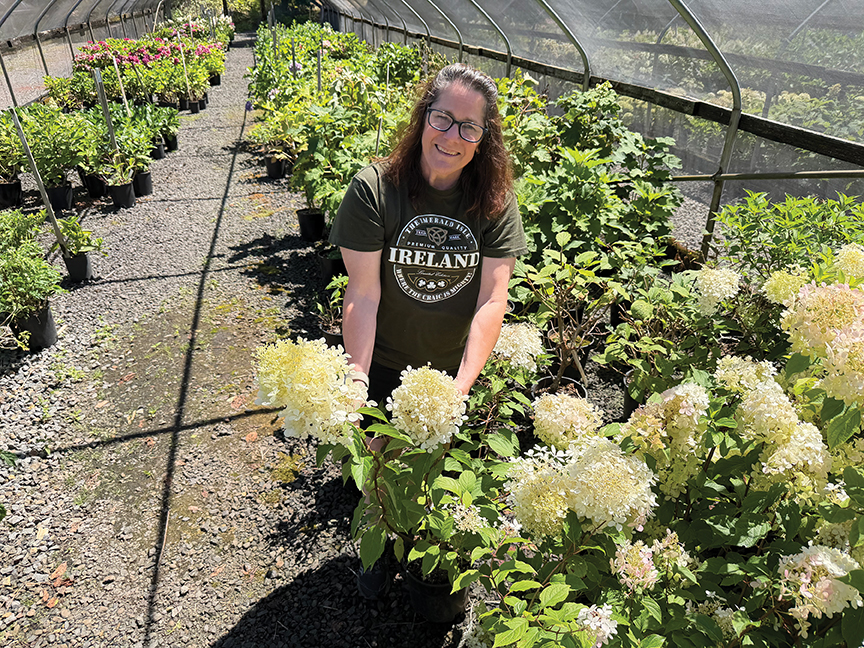
Kristin VanHoose is owner of Amethyst Hill Nursery (Aurora, Oregon) and was OAN president in 2010–11. Photo by Vic Panichkul
Kristin VanHoose, Amethyst Hill Nursery
In the late 1980s and early ’90s, Kristin VanHoose had been on a pretty steady business track.
A native of the Tri-Cities area of Washington, she’d earned a B.S. in statistics and an MBA from Washington State University. She went on to work in finance for a few years and transportation for a few more. VanHoose then got her accounting certificate from Portland State University in 1999 and was just about to sit for the Certified Public Accountant exam when she and her husband, David, stumbled onto something: a nursery for sale near the bucolic city of Aurora, Oregon.
“We had been looking for a business and had kind of landed on the idea of a tree farm,” VanHoose said. “We were looking at land, and we’re like, ‘Oh, this just seems like a lot of work to start a business from scratch.’ Then David just happened to read about this nursery for sale in the Oregonian, [a newspaper in Portland]. We went out on February 14, 1999, and walked around with the owners. And then we just kind of jumped off a cliff and bought it on June 1 of 1999.”
Today, more than 27 years later, that nursery has grown into VanHoose Enterprises, the parent company of the wholesale Amythest Hill Nursery and the retail-focused Hydrangeas Plus. The company specializes in hydrangeas and boasts one of the largest selections in North America.
“Hydrangeas are one of the most popular plants,” VanHoose said. “People love them. They remind them of their family or their grandmother, their mom, their dad or their grandfather. They’re kind of an emotional plant that way. I’m still buying new varieties. I don’t know why I keep doing that … but I think we’re up to 380, 390 different varieties now.”
While her husband largely focused on his career as an electrical engineer in Vancouver, [Washington,] VanHoose ran the nursery after the purchase, initially collaborating closely with the former owners, Art and Terri Bell, who’d originally founded it as Bell Family Nursery in the 1980s.
“We were lucky enough that they would come a couple times a week,” VanHoose said. “Art would come and we’d walk around doing all the outside stuff, the chemicals and irrigation. And Terri was really the hydrangea lover. We would do the inside stuff, and she’d help me with the pronunciation. I had all these flashcards so I could pronounce all the different hydrangea names.”
VanHoose was an early adopter of online selling, as far back as 1999. As the business grew, she also got more involved with the nursery industry in Oregon. She became active in the Oregon Association of Nurseries, first serving on committees, then taking on various officer roles until she became president in 2010.
Those times were tumultuous ones for nurseries, which like many industries, had been hit hard by the Great Recession of 2007–09. That was also when Phytophthora ramorum, which causes sudden oak death, was first discovered in Southern Oregon. That discovery led to significant testing at nurseries and a pre-notification requirement for nurseries shipping trees and shrubs outside the state.
“It was really a damper to free trade and getting plants to their destinations,” VanHoose said, “but being the Oregon growers that we are, I think we really stayed ahead of the problem.”
As for the United Nations designating 2026 the International Year of the Woman Farmer, VanHoose said it’s nice anytime women are honored, particularly in industries that have traditionally been male dominated.
“I think sometimes we’re expected to be running the business and running our family and doing everything else that all of that involves,” she said. “I do think it’s nice to be recognized, but I don’t know if the woman farmer is any different than women in any other industry.”
An avid reader who, surprisingly, loves to visit garden centers on her downtime, VanHoose said what she’s always enjoyed most about the nursery industry is the people who work in it.
“It’s just such a welcoming industry compared to others,” she said. “The people are just amazing. Even though they are your competitors, they’re still your friends.”
Owning a nursery also allowed VanHoose and her husband to be present in the lives of their children — two daughters and an exchange student from Europe who lived with them — as they grew up. They were able to volunteer in the community, take their kids to dance classes and soccer practice, and were otherwise just fortunate to be available for them throughout their young lives.
The kids are grown now, with the youngest finishing up college in the next year. They still come back to the nursery to help out on busy weekends, but whether any of them want to take it over in the future remains to be seen.
“I don’t think we’re going anywhere soon,” VanHoose said. “We’ve kind of built this up, and I would hate to just let it go. It’s possible one of the kids might be interested, but I don’t know if they realize how much work it is. I guess we’ve made it look so easy.”
From the October 2026 issue of Digger magazine | Download PDF of article