




The IR-4 Environmental Horticulture workshop happens every two years. It’s where researchers, stakeholders, and industry representatives get together to prioritize projects for the next two years. Photo Courtesy of IR-4 Project

Since 2025, I have served as leader of the IR-4 Pesticide Registration Field Research program at Oregon State University. The program is based at the North Willamette Research and Extension Center (NWREC) in Aurora, Oregon, and runs all the field trials necessary for registering new pesticides in specialty crops.
In recent years, this program has focused mainly on food crops. Since we are surrounded by the nursery industry, however, I wanted to learn more about pest management and product registration for ornamentals.
My background and experience are in entomology, so I was also fascinated to learn about plant pathology and weed management issues in the nursery industry. This article outlines my experiences and impressions from my first IR-4 Environmental Horticulture workshop, and the impact it can have on the Oregon nursery industry.
A cycle that’s responsive to needs
Unlike the IR-4 Food Use program, which runs on a yearly calendar, the IR-Environmental Horticulture (EH) program has a biennial cycle (Fig. 1).
The IR-4 Environmental Horticulture workshop happens every two years. It’s where researchers, stakeholders, and industry representatives get together to prioritize projects for the next two years. The goal is to narrow down and select research projects where one or several pesticide products are tested for efficacy and/or crop safety in various ornamental crops.
The 2025 IR-4 EH workshop took place over two days in October in Kansas City, Missouri, coordinated by a new IR-4 Environmental Horticulture management team. Being just seven months into my new position, I was curious to learn not only how this workshop would be carried out in general, but also to see what changes and improvements the new leadership would bring to the program.
Historically, IR-4 EH has gathered data on pest management needs in two ways: by doing a grower survey, or by soliciting project requests (TinyURL.com/IR4HortGrowerSurvey).
With the survey, growers, consultants, or extension agents indicate which pests (weeds, pathogens, or invertebrates) are their primary concern. With the project requests, (mainly) researchers submit nominations for specific pesticide products that they would like to evaluate against specific pests. In the March 2025 issue of Digger, Jerry Weiland, Ph.D., from the USDA Agricultural Research Service (Corvallis) wrote about the importance of participating in these surveys to ensure that the pest management needs of the local industry are heard and met (DiggerMagazine.com/Prioritizing-Nursery-Pest-Challenges).
Deciding which products to evaluate
In the past, both the grower surveys and project requests were considered during the process of selecting the final list of IR-4 EH projects. One of the main changes at the 2025 IR-4 EH workshop was to prioritize the data from the grower surveys over the project requests when nominating and selecting projects. The project requests could then be used as a tool to identify potential products to evaluate for the main pest issues stated by the grower survey.
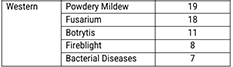
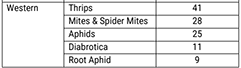
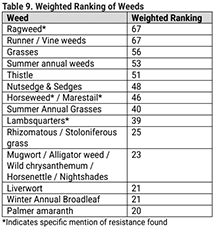
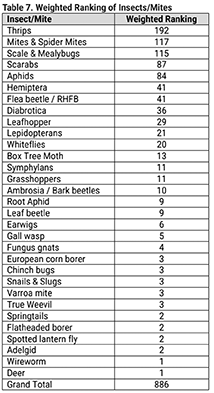
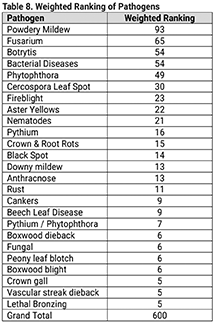
For the grower survey, respondents were asked their top three pest problems per discipline, and then all the answers were given a final weighted ranking.
One of the main questions was, “Consider the plant materials you grow or maintain. Then, consider situations over the last year where you had difficulty managing diseases, pests, or weeds. For all three areas, list the top three situations where your product arsenal was limited.” We were also able to assess pest problems by regions (with Oregon as part of the Western Region), or by type of crop (e.g., cut flowers, shrubs, etc.).
One thing to consider is that the overall national needs may not address the specific needs of the Western Region, and that the overall needs of the Western Region may not reflect the needs of Oregon growers.
The survey tables show the national and regional answers to the top pests. Some pests that are consistently challenging, both nationally and regionally, include thrips, powdery mildew, and runner/vine weeds. In contrast, some pests that ranked high (top 5) in the Western Region that were not ranked as high nationally include root aphids, fire blights, and mugworts.
When a pest is selected as a national or regional priority, it increases the likelihood that effective products will be evaluated and registered for ornamental crops.
Low participation of a particular region or sector means that their needs may get diluted by the needs expressed by more active survey participants. This may be the case with the Western Region, which had the lowest response rate of all the U.S. regions, with a total of 62 responses out of 335 participants (19%).
Likewise, some types of operations or crops may be underrepresented. For example, the vast majority of respondents represented greenhouse operations (200 responses), and listed cut flowers as their main crop (196 responses). While it may be that this is a true representative slice of the market, it may also be that these responses represent the most active stakeholders. Grower input at this stage helps ensure that future registrations align with real-world nursery production challenges.
(For online readers, the summary of the 2025 Grower Survey can be accessed at TinyURL.com/IR4GrowerSurvey, and the specific project requests are available at TinyURL.com/IR4ProjectRequests).
Focusing on priority projects
The initial goal was to select a total of 10 national priority projects (balanced per discipline; weed science, plant pathology, and entomology), plus two regional priorities regardless of discipline (Northeast, North Central, Western, and Southern regions). In the past, the projects were also equally divided into crop safety and efficacy.
After reviewing all the top pest issues according to the grower survey, we broke into regional groups (in my case the Western Region), where we discussed whether the top pests from the national survey were a local issue and we should pursue prioritizing them for projects.
After discussion with our regional groups, we reconvened with the whole group, and we started evaluating the top pests by discipline. The weed scientists were quick and organized to select their national project priorities:
- Pre-emergent herbicide crop safety in hydrangeas.
- Early post-emergent herbicide efficacy in Christmas trees.
- Pre-emergent herbicide efficacy and crop safety in transplant cut flowers.
- Perennial weed herbicide efficacy in cut peonies.
As the discussion flowed, some aspects of project selection became more flexible and fluid – for instance, initially half of the projects were to be allocated to evaluate pesticide efficacy and half to crop safety, but several attendees and stakeholders pointed out that they already assess crop safety when doing efficacy trials, so in some cases they can be combined and priority be given to the efficacy trials.
The rest of the national priorities arose as the coordinators of the different regions consulted with one another if a top pest was an issue only specific to one area, or if it was a more widespread problem. This was the best way to allocate finite resources to ensure that most pest needs are addressed. From these discussions, the national priorities (top pests that were issues in at least two regions) for plant pathology and entomology were selected:
Plant pathology national priorities:
- Phytopythium fungicide efficacy.
- Phytophthora fungicide efficacy.
- Botrytis efficacy.
- Entomology national priorities:
- Thrips insecticide efficacy.
- Red-headed flea beetle insecticide efficacy in container nurseries.
- Root aphid insecticide efficacy.
- The plant pathology projects, unlike the weed science projects, did not have a designated crop, because the crops affected may vary among regions.
For example, I was aware that Phytophthora is an issue for Christmas tree growers in the Pacific Northwest, but nursery growers in other regions may experience problems with Phytophthora in different crops such as potted plants. The advantage of selecting Phytophthora as a national priority is that each region will have the resources to develop a protocol that fits their crop of interest.
A similar discussion arose with the entomology projects. All regions agreed that thrips were a main pest, but each region had a different species or crop to prioritize. For instance, the main thrips species in the west is the Western flower thrips, while in the Southeast, chili thrips and the newly invasive parvispinus thrips are the main concern.
Addressing what fell below radar
After the national priorities were selected, each region now had the opportunity to nominate their own regional projects in any of the disciplines. This provides the opportunity to solve local problems that might fall under the radar when assessing national grower’s surveys. Because more projects (four) were selected for weed science as a national priority, entomology and plant pathology were the focus for selecting regional projects.
For the Western Region, the two regional priorities selected were both in entomology, to evaluate products for efficacy against symphylans (which can clog irrigation systems in nurseries) and scale (affecting mainly woody ornamentals). The Western region encompasses 13 states, so the needs are very diverse, but in the end, I hope that the results of this priority setting workshop will benefit the Oregon nursery industry. These priorities ultimately determine which pesticide products may become labeled for ornamental use in the next several years.
What’s next? In cooperation with registrants (pesticide manufacturers), IR-4 EH leadership is screening potential products that would be a good fit to evaluate in each of the priority projects, and drafting the protocols for each trial (Fig. 2). Concurrently, the regional leaders are reaching out to researchers to assign who can run each of the trials, ideally in a local crop of importance. The researchers are then responsible for performing the field trials following the protocols to evaluate for efficacy and/or crop safety, collecting the data, and writing the final reports.
One thing to point out is that, unlike for food use crops, product registrations for ornamentals do not require residues analyses. Once all the field trials are completed and the data from all regions is collected, IR-4 submits the reports to the manufacturers so that they can request registration of the products evaluated that showed good efficacy without injuring the crops.
As a newbie in this program, my whole impression of the IR-4 EH workshop was strongly positive. I will admit — I wish I had been better prepared to give specific insights about the pest management problems faced by the Oregon nursery industry, but it is a learning process that will help me become a more efficient advocate.
It was also fascinating to learn about problems in other regions that we would not even consider here. This is why is so important to fill the grower’s surveys! Make sure that the local needs of your region are seen and addressed.
I would like to encourage more industry representatives and stakeholders to attend in person the IR-4 Environmental Horticulture workshop in the future. It truly makes an impact to have your input in the room! It makes the difference between having one project discarded or not. In the end, we do it for the growers, and to ensure that the ornamental industry continues to thrive.
Dalila Rendon is assistant professor in the Department of Horticulture at Oregon State University. She specializes in IR-4 field pesticide research and pest managment in specialty crops. She can be contacted at Dalila.Rendon@OregonState.edu.