




The scale of the Farwest Show can be a little overwhelming to the uninitiated with rows of amazingly decorated booths, equipment and familiar nursery names vying for attention. Photo by Vic Panichkul
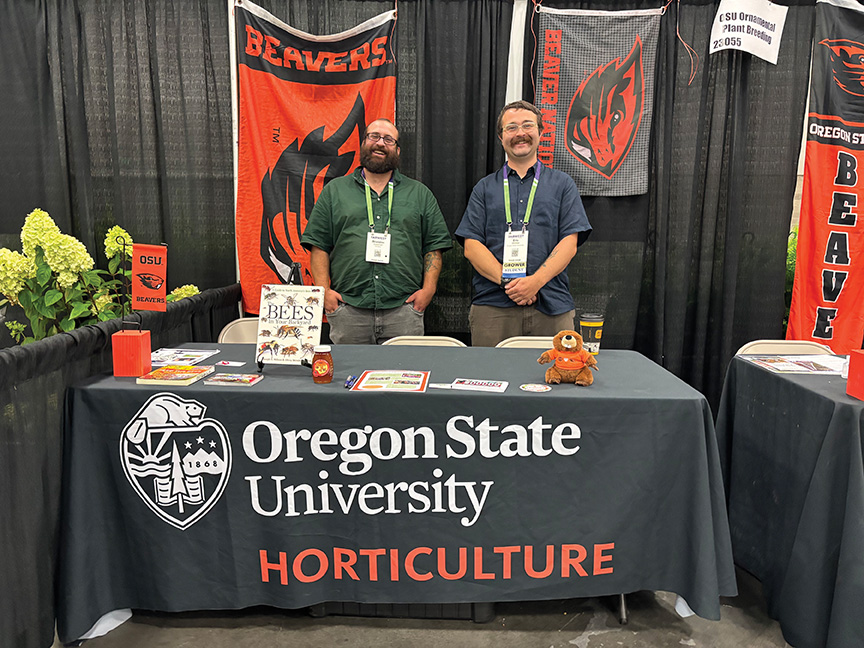
Oregon State University students Brandon Spellman and Eric Whittier staff the university’s booth at the Farwest Show. Photo by Lloyd Nackley
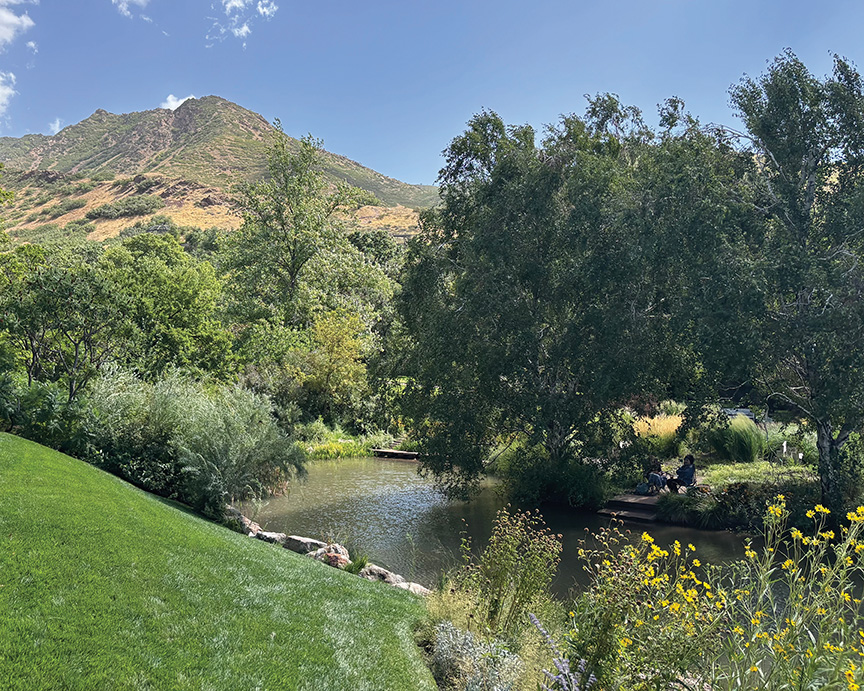
In the dry foothills above Salt Lake City, Red Butte Garden felt like an oasis of large trees, flowing water, hidden benches and views across the valley. Photo by Lloyd Nackley
There is something fun about bringing people to their first Farwest Show.
The scale can be a little overwhelming to the uninitiated. The rows of amazingly decorated booths, oversized equipment, familiar nursery names everywhere, new introductions competing for attention, educational sessions happening around the edges, and thousands of people who somehow all seem to know one another.
This year, watching our students take it all in reminded me of my own first walks through those aisles about a decade ago.
A lot can happen in 10 years. These days, Farwest feels increasingly familiar. I see old friends across the aisle, run into growers we have worked with on research projects, and inevitably spend more time talking than I planned.
But now I am noticing something else. Students who once came through our programs are showing up again, this time as members of the industry. I was reminded of that when someone hollered my name across the show floor.
It was Tommy, a former Oregon State University student who had worked with us at the North Willamette Research and Extension Center four years earlier, through the ODA/OAN-sponsored internship program. I remember Tommy especially for the positive attitude he carried through a hot summer helping us establish a new research field.
The farm crew had generously left us a thick stand of pigweed and Canada thistle to begin with, and Tommy would drive up from Corvallis and diligently run the tiller, helping us reclaim the ground. His work paid off. That field went on to become home to the Climate Ready Landscape Plant demonstration garden and, today, The Great Tree Race. He came from an agricultural background, but not a nursery background. After he graduated, we lost touch.
Now here he was at Farwest. Tommy told me he had gone to work for a conifer grower in Marion County after graduation, and had since moved into a sales position with a nursery in the Washington County area. The student who had once been driving up from Corvallis to till our research plots was now walking Farwest as a nursery professional.
It was one of the highlights of the show for me this year.
And Tommy’s story is hardly unusual. Walking through Farwest puts the passage of time in sharp relief. Many of the people running booths and businesses today are the children or grandchildren of people who helped build Oregon’s nursery industry. Students become employees. Employees become managers. Businesses pass between generations. Once a year, much of that history ends up walking the same aisles.
Bringing in the interns
This year we brought another group of students to begin making some of those connections. Our NWREC interns — Eric, Brian and Lucy — attended their first Farwest. Their work experiences were supported by the Oregon Department of Agriculture in partnership with the Oregon Association of Nurseries through the nursery research program.
Other interns from OSU’s horticulture programs were there as well, representing work in ornamental plant breeding, weed science, and landscaping. And they weren’t there just to wander around looking at plants.
Students presented their internship experiences at the Solution Center and met people from across the industry. They also participated in NexGen, OAN’s group for people who are new to the nursery and greenhouse industry or moving into the next stages of their careers. Our Ph.D. student, Zoie Yetley, participated in Career Boulevard, a newer Farwest feature designed to connect people with careers, internships, scholarships and employers across the green industry.
Zoie was able to talk with visitors about something most people outside of a university probably don’t encounter very often: what it is actually like to be a graduate student studying nursery production.
Those opportunities matter. A student can learn a tremendous amount in a classroom, greenhouse or research plot, but an industry becomes much more tangible when you meet the people who make their living in it. Suddenly “horticulture” isn’t a major printed on your transcript. It is growers, breeders, salespeople, researchers, propagators, equipment manufacturers and dozens of careers you might not have known existed.
Farwest also remains one of the places where our research gets out of the plots and into conversations with growers. Clint Taylor presented our work looking at arborvitae field-production optimization and how container production practices affect plant growth and water use.
Silvia Rondon, director of the Oregon Integrated Pest Management Center, discussed the work of the Oregon IPM Center and efforts to prevent pesticide resistance in nursery production. Luisa Santamaria discussed vascular streak dieback, an emerging disease of woody ornamentals that growers and researchers are watching closely.
One thing I appreciate about presenting research at an industry meeting is that the conversation rarely ends when the slides do. Growers have observations from thousands or millions of plants that we could never reproduce at a research station. A researcher may have the microphone for 30 minutes, but often the interesting part begins afterward when somebody walks up and says, “Here’s what we’re seeing at our nursery.”
That exchange is one of the reasons events like Farwest continue to matter.
Of course, there are also plants. The New Varieties Showcase is always worth a visit, and the judges had plenty to choose from this year. The official selections included a Best in Show and several Awards of Merit among the new introductions on display. But the judges had their favorites, and I had mine.
My unofficial awards went to two introductions from Iseli Nursery: Deja Blue blue spruce, and a variegated black mondo grass. Both were, in the technical language of plant science, ice cold. There were even puppies this year near Career Boulevard, available for adoption through a local animal shelter.
I told myself I wasn’t going to write about the puppies. But they were very cute.
By Friday morning, after a long week, the show had relaxed a little. People were catching up with friends, conversations lingered longer, and a few attendees were already wandering the aisles with tallboys of beer. Farwest is a trade show, an educational meeting, a marketplace and, by the end, something of a reunion. A few days later, I headed to Utah for a horticultural gathering that felt very different.
From green to gold
Traveling from Oregon’s Willamette Valley to Salt Lake City for the International Plant Propagators’ Society Western Region meeting felt like changing palettes. The greens and grays of western Oregon gave way to the yellows, blues and browns of the Wasatch Front.
The meeting changed scale, too. Farwest brings thousands of people through a convention center. IPPS brought together closer to a couple hundred plant people who spent several days listening to one another, touring nurseries and gardens, riding buses together and talking about plants.
The distinction is hard to describe until you experience both. Farwest presentations often feel like teaching. IPPS presentations feel more like sharing. That’s not to say one is better. They serve different purposes.
At IPPS, speakers come from within the group. Tours are woven into the meeting rather than being something that happens before it. The person speaking about propagation in the morning may be sitting beside you on the bus that afternoon. The organization’s motto is “Seek and Share,” and the meeting takes that pretty literally.
This year’s meeting, organized by Boston Swan of Utah Valley University and others in the region, also reflected the landscape around us. Conservation, drought and plant adaptation kept surfacing in conversations.
Utah is dealing with serious water challenges. We heard stories from multigenerational farmers who could remember a time when water reaching the Great Salt Lake was viewed almost as wasted water. Now the region is confronting the opposite problem: how to keep an iconic lake and unusual ecosystem from disappearing.
At the same meeting, attendees from Maryland described a completely different kind of climate stress. They had experienced early temperatures around 90 F, followed by temperatures below freezing. For some field-grown Japanese maples, the swing cost nearly an entire year of growth. Other crops had to be discarded. Different sides of the country. Different problems. Same uncomfortable reminder: plants don’t get to grow under average conditions.
One presentation in particular stayed with me. Scott Skogerboe described a lifetime spent searching the Intermountain West for unusual plants. He talked about traveling to isolated mountain ranges and little-explored peaks, including southern populations of bur oaks and native junipers, looking for individuals with unusual foliage, growth habits or other characteristics worth preserving. Finding an unusual plant is exciting enough for a group of plant people. But the larger idea was much more interesting.
Plant species have already survived extraordinary environmental change. Glaciers have advanced and retreated. Seas have risen and fallen. Landscapes have warmed, cooled and dried. Populations have become isolated, and in some of those refuges, distinctive genetics persisted. Those unusual populations may contain traits that helped plants survive conditions different from those experienced across most of their current range.
As we think about a warmer and less predictable climate, some of those genetics could become increasingly valuable. Horticulture has an opportunity not only to preserve that diversity, but to identify it, propagate it and bring useful plants into cultivation.
Gardens and seed
That idea followed us onto the IPPS tours. At Red Butte Garden and Arboretum at the University of Utah, our guide spoke about trees almost poetically. You could tell he didn’t simply manage a collection. He cared deeply about the individual plants and the landscape they created. And what a landscape it was.
In the dry foothills above Salt Lake City, the garden felt like an oasis of large trees, flowing water, hidden benches and views across the valley. I confess to experiencing a little professional jealousy. It was the kind of university garden that makes you imagine what might someday be possible on your own campus.
Another tour showed us a completely different side of horticulture. At Granite Seed, we saw the scale of an operation required to collect, produce, clean, process, blend, sell and distribute seed across the West. The facility felt more like a factory than a nursery — warehouses, equipment and enormous quantities of seed moving through a vertically integrated system. Yet what ultimately comes out the other end are grasses and wildflowers.
If Red Butte showed what people can create with plants, Granite Seed showed some of the infrastructure required to put plants back onto western landscapes at enormous scale.
Different meetings, same industry
At Farwest, I found myself thinking about what can change in a decade.
At IPPS, I found myself thinking about what plants have survived over millennia.
The two meetings could hardly have felt more different. Farwest is big and energetic. IPPS is smaller and slower. But both reminded me that horticulture moves forward in much the same way.
A student attends her first trade show and discovers careers she didn’t know existed. A former intern hollers at you across the aisle four years later, now building a career in the industry. A grower tells a researcher what is actually happening in the field. A breeder puts an unusual plant in front of hundreds of people. Someone who has propagated plants for 40 years shares an observation with someone who has been doing it for six months.
Watching our students walk into Farwest for the first time this year, I remembered what those aisles looked like to me a decade ago. Someday, I suspect, some of these students will be the familiar faces across the aisle. They may be running nurseries, developing new plants, solving production problems or bringing their own students along for the first time.
The plants will change. The technology will change. The challenges certainly will. The important part is that we keep bringing new people into the conversation and keep sharing what we learn along the way.
From the October 2026 issue of Digger magazine | Download PDF of article